
The Foundational Reading Report You Need to Read



Phonics instruction is not one-size-fits-all. See how critical research has led Scholastic to reinvent the way students learn to read.
How children learn to read has been debated by researchers for nearly a century. However, for the past two decades, the science of reading has remained largely consistent. Systematic phonics instruction has been proven to lead to gains in decoding and comprehension across the board for all K–1 students, regardless of socioeconomic background, disabilities, or risk of developing future reading problems.
In the late 1990s, the National Reading Panel, a group of expert educators and scientists, concluded that in order to become a confident reader, students must master five foundational reading skills: phonemic awareness, phonics, fluency, vocabulary, and comprehension.
However, the way in which all students obtain these five foundational skills is where the research often varies based on each individual learner.
We all want our students to read fluently and well—but the reality is that students acquire these skills through different practices and at different speeds. One size does not fit all. Reading instruction must adapt to meet each individual learner’s needs.
So what is the answer? At Scholastic, we believe the solution is not just one program or single method, but rather what works best for each student to reach proficiency across all five foundational skills. The more adaptive and flexible the instruction is for the student, the better.
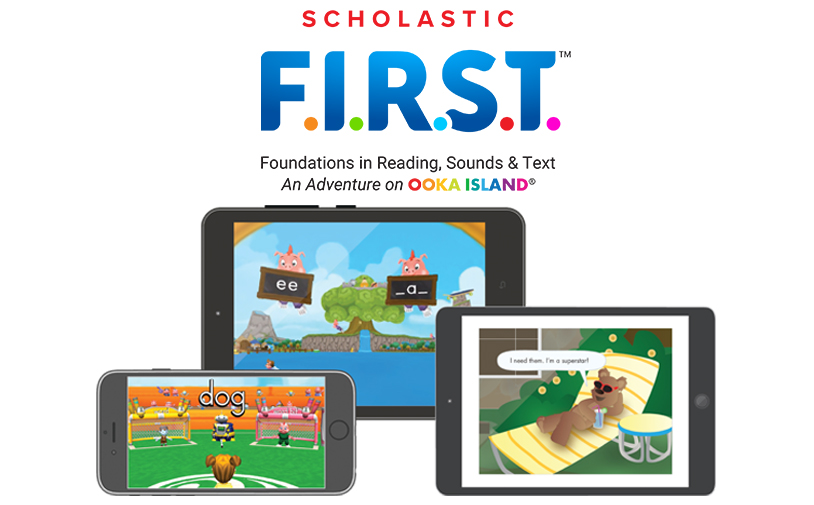
Our newest reading program does exactly that. Scholastic F.I.R.S.T. has reinvented the way students learn to read by combining highly adaptive, personalized learning with a robust and research-based scope and sequence covering all five foundational reading skills.
Download this free research report today to see exactly how Scholastic F.I.R.S.T. helps every student become the fluent, proficient, and confident reader he or she deserves to be.
Scholastic F.I.R.S.T. leverages adaptive technology and game-based learning to teach beginning readers the 44 sounds in the English language and the more than 6,000 micro actions needed to become fluent readers.